

Controls & Transformers
Questions and Answers
Controls have a function available that is called retraction. This describes an action of the pneumatic cylinder or servo. Retraction can speed up the weld operation when repeating like welds near each other. We don’t want the cylinder to open fully just enough to allow part or gun movement to the next weld location. Then the weld repeats. Another example is to open enough to load the next part but not full open to reduce cylinder travel time.
Repeat or pulsing refers to repeating the weld and hold portion of a weld schedule. Normally there is a very short off period of one or two cycles with continued application of force between the two weld sequences. This gives you the ability to dissipate the heat energy a little further into the part away from the center of the weld nugget.
Squeeze is the first segment of the weld schedule. It’s function is to apply force on the work pieces to bring them together. This pressure under the face of the electrode in turn makes good electrical contact and controls and contains the resultant weld nugget during the weld and hold portion of the weld cycle. If current is applied prematurely before the proper force has been reached these functions will be compromised and expulsion and poor nuggets should be expected.
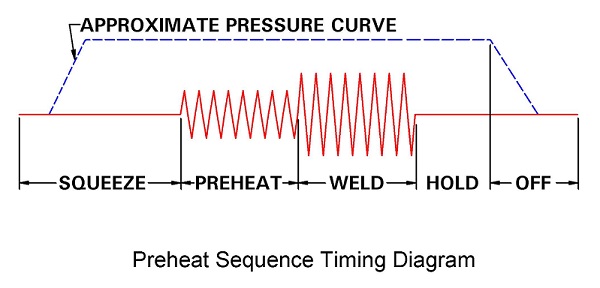
Squeeze time is the first sequence of a weld schedule. It is designed to allow the electrodes to close and build up full force on the parts before current is applied. If squeeze time is too long it does not hurt the welding operation but it does increase the cost of the total operation by increasing the total time of the weld schedule and thus fewer parts per shift.
Spot welding can decrease in weld size as you weld across the part. One cause for this is increasing magnetic material in the throat of the welder as you move across the part. Most parts are low carbon steel which is a magnetic material. In AC welding applications, if after each weld more material is moved into the throat of the machine, the weld current will decrease.
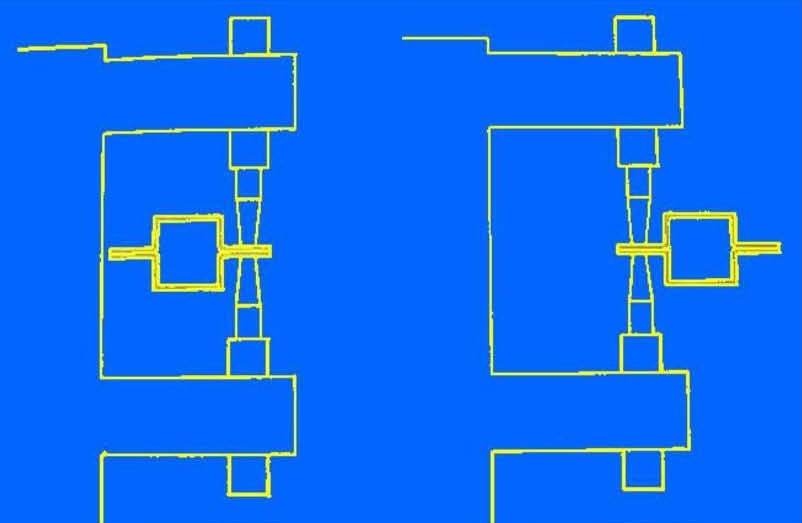
METAL IN THE THROAT CAUSES IMPEDANCE TO INCREASE
Page 33 of 40
Have a Question?
Do you have a question that is not covered in our knowledgebase? Do you have questions regarding the above article? Click here to ask the professor.